Medical information about teeth whitening methods in Bursa. Causes of tooth discoloration, in-office and at-home whitening stages, and the post-procedure process.
Bursa Teeth Whitening (Bleaching): Causes of Discoloration, Application Methods, and What You Need to Know
The oral and dental structure is directly affected by many different variables such as dietary habits, genetic factors, and advancing age. Although the color of healthy tooth enamel varies from person to person, over time, darkening may occur in the natural shade of the teeth due to external or internal factors. The process of lightening these structural color changes at the cellular level using medical agents, which cannot be removed by mechanical procedures such as tooth brushing or standard tartar cleaning, is called "teeth whitening" (bleaching). Teeth whitening procedures, frequently researched in the field of dental health in Bursa, may seem like merely an aesthetic request, but in fact they are a clinical procedure in which the biological structure of the enamel and dentin layers is intervened upon. In this guide, the medical mechanism, uses, and methods of teeth whitening treatment are discussed within an objective framework.
Why Do Teeth Discolor?
Before moving on to teeth whitening treatment, correctly identifying by the dentist why the tooth has changed color is essential for the success of the treatment. Tooth discolorations are generally grouped under two main headings in the medical literature:
1. Extrinsic Discolorations: These are color changes that accumulate on the outermost layer of the tooth, the enamel, or in the microscopic pores on its surface. Foods and tobacco products with intense pigmentation, such as tea, coffee, red wine, and cherry juice consumed daily, are the main causes of this condition. They can usually be controlled to a large extent with good oral hygiene and tartar removal (scaling) performed in a clinical setting.
2. Intrinsic Discolorations: These are color changes that have penetrated the dentin tissue beneath the enamel layer and cannot be removed by brushing or superficial cleaning.
Aging: As age advances, the outer transparent enamel layer becomes thinner, and the yellowish dentin layer underneath becomes more visible.
Medication Use: Tetracycline-group antibiotics used during tooth development (childhood) or while in the womb can cause deep gray-yellow bands in the teeth.
Trauma: Physical impacts to the tooth can cause bleeding in the living tissue inside the tooth (pulp) or cause it to lose vitality, darkening the tooth from the inside out.
Fluorosis: Excessive systemic fluoride intake during tooth development can create white or brown spots on the enamel surface.
Standard cleaning procedures are insufficient in the treatment of intrinsic discolorations; in such cases, medical whitening (bleaching) performed with chemical agents is used.
How Does Teeth Whitening Work?
Teeth whitening is based on the principle of chemically breaking down the pigment molecules that give the tooth its color. In this process, gels containing hydrogen peroxide or carbamide peroxide are generally used as the main active ingredient.
These compounds, applied to the tooth surface under the supervision of a dentist, enter through microscopic pores in the enamel layer and reach the dentin layer. There, they separate into oxygen radicals and initiate an oxidation reaction. The oxidation process breaks down the large, dark pigment molecules embedded in the tooth and converts them into smaller, colorless molecules. As a result of this chemical reaction, there is no wear or loss in the physical integrity, enamel structure, or form of the tooth; only the color-causing substances within the tissue are neutralized.
What Are the Teeth Whitening Methods?
In healthcare institutions in Bursa, there are different whitening protocols applied according to the patient's expectations, the degree of discoloration, and time constraints. The choice of method is made after a clinical examination.
1. In-Office Whitening (Clinical Setting)
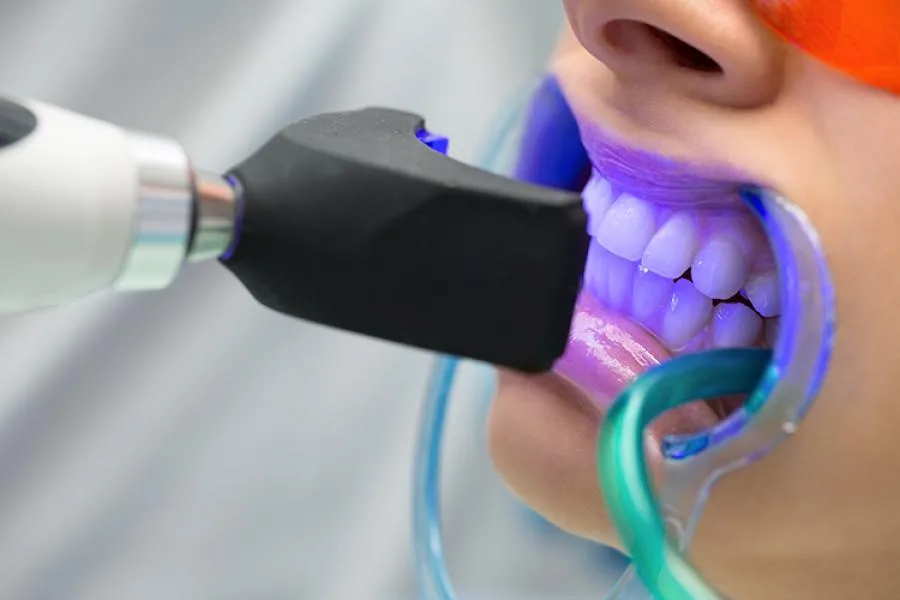
This is the fastest professional method, applied directly in the clinic by the dentist. Before the procedure, the gums are covered with a special protective barrier (gingival barrier) to prevent the chemical substance from damaging the soft tissues. Then, a high-concentration whitening gel is applied to the tooth surfaces. Special medical light devices (LED or laser) may be used to accelerate the activation of the gel. The procedure is usually completed on the same day by repeating several sessions at 15-20 minute intervals.
2. At-Home Whitening
This is a method that the patient applies at home on their own, but entirely under the planning and supervision of the dentist. The dentist takes impressions of the patient's mouth and prepares custom-made, transparent trays that fit the teeth exactly. Whitening gels with a lower concentration than the in-office type are placed into these trays by the patient. According to the schedule determined by the dentist (usually 4-6 hours a day or throughout the night), it is used for an average of 1 to 2 weeks.
3. Combined (Dual) Whitening
This is the use of in-office and at-home methods together in resistant cases with advanced discoloration. After the quick and effective session performed in the clinic, treatment is continued for a few more days with at-home trays in order to reinforce and deepen the result obtained.
4. Single-Tooth (Internal / Endodontic) Whitening
This is a special procedure applied to individual teeth that have undergone root canal treatment and have darkened over time because they have lost vitality. The filling inside the tooth is removed, the whitening agent is placed into the pulp chamber, and the tooth is covered with a temporary filling. The substance is renewed every few days until the desired color is achieved. Once the ideal shade is reached, the tooth is permanently restored.
Clinical Evaluation Before Teeth Whitening in Bursa
Teeth whitening cannot be directly applied to every oral structure. A comprehensive dental examination is mandatory before the procedure. If there is tartar in the patient's mouth, scaling should first be performed and the tooth surfaces should be made smooth.
In addition, if there are active cavities, cracked teeth, worn enamel tissues, or exposed root surfaces due to gum recession in the mouth, the whitening procedure is postponed. If the whitening gel comes into contact with cavities, the acid can directly reach the tooth's nerve (pulp) and cause very severe pain. Whitening protocols are not started without resolving such structural problems.
Who Is the Procedure Not Applied To?
Some situations in which teeth whitening, a medical intervention, is contraindicated (considered unsuitable for application) are as follows:
Pregnant and breastfeeding women (because there is insufficient clinical data on the systemic effects of the active ingredients).
Individuals under 18 years of age (because the pulp chamber and nerve canals inside the tooth are wider at these ages and carry a risk of permanent sensitivity).
Patients with advanced gum recession and largely exposed tooth roots.
Individuals whose enamel layer is developmentally very thin or who have severe wear problems.
Those with extensive porcelain veneers or composite fillings in the front part of the mouth (whitening gels do not lighten the color of artificial materials; this leads to significant color mismatch between the teeth and the restorations after the procedure).
Recovery and Care Process After Treatment
After the whitening procedure, the micro-pores on the enamel remain open for a while. Therefore, the first 48 hours are extremely critical for maintaining the success of the procedure. In medical practice, this period is called the "white diet" process.
For the first two days, colored foods and tobacco products such as tea, coffee, tomato paste, red meat, turnip juice, and cherry juice should definitely be avoided.
After the procedure, temporary sensitivity (aching) to cold or air in the teeth lasting 24 to 48 hours is an expected physiological condition. Your dentist may recommend fluoride-containing gels or special desensitizing toothpaste to help you get through this process more comfortably.
The permanence of whitening depends entirely on the patient's consumption habits and oral hygiene. With regular brushing and check-ups, the result obtained can be maintained for an average of 1 to 2 years.
Legal Notice: This article has been prepared solely for the purpose of informing the public and raising awareness about oral and dental health, within the framework of the regulations on Promotional and Informational Activities in Health Services. The statements contained in the text cannot replace a dentist's professional examination, diagnosis, or personalized treatment planning. To determine the type of tooth discoloration and the appropriate treatment methods, it is necessary to apply to an authorized oral and dental health institution.