
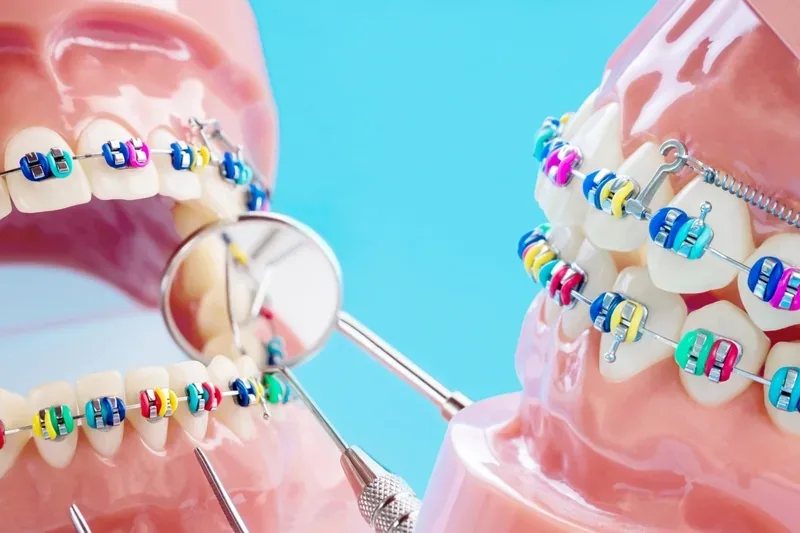
In my dental practice, orthodontics is one of the areas where my patients most often seek treatment for aesthetic concerns. Commonly known in society as "braces treatment," orthodontics is the specialty that diagnoses and treats tooth crowding, discrepancies between the jawbones, and bite problems. Although most of my patients come to the clinic saying only, "I want my teeth to look straight," as a dentist my goal is not only to create a perfect smile; it is also to protect proper chewing function and jaw joint health for life.
Why Is Orthodontic Treatment Not Just an Aesthetic Need?
Cleaning crowded and irregularly aligned teeth is quite difficult despite the use of a toothbrush and dental floss. These anatomical tightnesses pave the way for tartar buildup, gum disease, and inevitably, tooth decay at an early age. In addition, improper closure of the upper and lower jaws can cause excessive strain on the chewing muscles, clicking in the jaw joint (TMD), wear, and even chronic headaches radiating to the neck area. A properly planned orthodontic treatment eliminates all these mechanical problems and balances oral function, the first step of the digestive system.
What Treatment Methods Do We Use in Modern Orthodontics?
With advances in technology, our treatment options in the clinic have diversified to maximize our patients' comfort. Depending on the case and the patient's social life, the methods we most often use are:
Metal Brackets: This traditional system, which is the most durable, is highly successful in controlling tooth movement. It is still one of our most reliable tools, especially in solving severe crowding and complex bite problems.
Porcelain (Aesthetic) Brackets: These tooth-colored brackets were developed for our patients who are uncomfortable with a metallic appearance. Since they are very difficult to notice from a distance, they are an ideal alternative for adults with high aesthetic expectations.
Clear Aligners (Invisible Orthodontics): The biggest innovation digital dentistry offers us is clear aligners (aligner treatments). The patient's measurements are taken with three-dimensional digital scanners, and custom-made, removable clear aligner series are produced. Their near invisibility, ease of brushing, and the ability to remove them while eating have made this method one of the most popular options in recent years.
Is There an Age Limit for Orthodontic Treatment?
One of the most common misconceptions I encounter in the clinic is that braces are only for children or young people. In orthodontic treatment, there is absolutely no age limit. Any individual with healthy gums and sufficient bone support can safely undergo this treatment, even at the age of 40 or 50.
However, for children, the first examination should be performed at 7-8 years of age (when baby teeth fall out and permanent teeth begin to erupt), which is critical. Early intervention with special appliances (palatal expanders, etc.) during the growth period for skeletal problems such as delayed or narrow jaw development helps prevent difficult surgical operations that may be needed later.
What Should Be Considered During and After the Process?
Orthodontics is a journey that requires patience and close patient-dentist cooperation. Treatment duration generally ranges from 6 months to 24 months, depending on the anomaly. During this period, a slight feeling of pressure for a few days, especially during wire adjustments, is normal due to the forces applied. The most crucial point in the process is oral hygiene. My patients who wear braces can prevent cavities by meticulously cleaning around the brackets with interdental brushes.
When treatment is completed and the braces are removed, we either fix a very thin wire to the back surface of the teeth or provide protective clear aligners to prevent the teeth from shifting back to their original position. This final stage, which we call "retention treatment," is the only guarantee that the healthy and aesthetic result we have achieved will be permanent.