
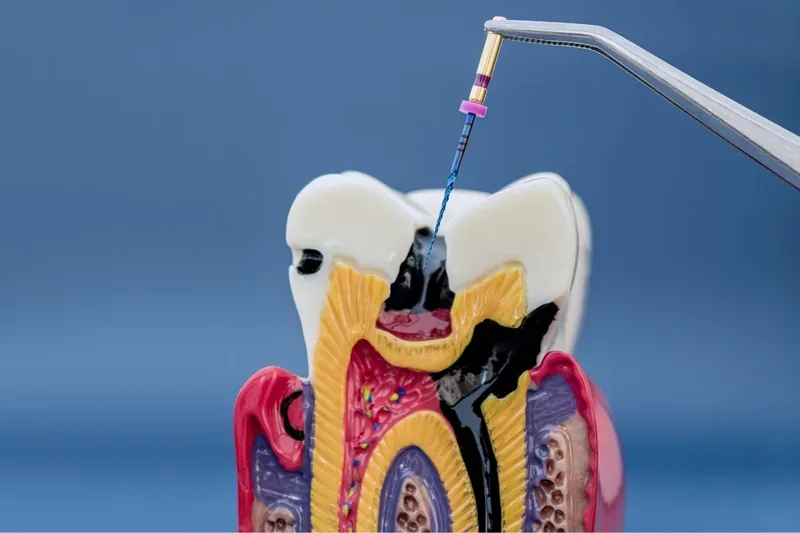
In my clinical practice, root canal treatment is undoubtedly one of the procedures my patients sit in the dental chair most anxiously for. However, contrary to popular belief, this treatment is the most critical and life-saving medical intervention that allows us to keep the tooth in the mouth without losing it. Known in the medical literature as endodontic treatment, it is the process of cleaning the living nerve and vascular tissue called the "pulp" located in the center of the tooth when it becomes infected or loses its vitality, and then sealing the inside of the tooth with biocompatible materials.
Why Is Root Canal Treatment Needed?
Progressive tooth decay that is not treated in time eventually passes through the enamel and dentin layers and reaches the core of the tooth, namely the pulp chamber. When the bacteria that cause decay settle in this area, acute symptoms such as throbbing nighttime pain, extreme sensitivity to hot and cold, a feeling of pressure when chewing, and swelling in the face occur. It is not only decay; tooth fractures or cracks caused by trauma can also expose the nerve tissue and pave the way for serious infections. In such a case, instead of telling the patient, "We need to extract your tooth," we perform root canal treatment to eliminate the infection at the root tip and keep the tooth functional in the mouth.
How Does the Treatment Process Proceed?
The process begins with a detailed radiographic analysis in which we examine the tooth and the surrounding bone tissue. After determining the root anatomy and the extent of the infection, we completely numb the relevant area and isolate the tooth. Once the pulp chamber is reached, the inflamed or necrotic (dead) nerve tissues inside the root canals are mechanically and chemically cleaned using millimetric flexible instruments (files) and powerful antibacterial solutions.
After the canal spaces are completely cleared of microorganisms and shaped, they are tightly filled all the way to the root tip with special rubber-based materials (gutta-percha). Depending on the severity of the infection and the condition of the tooth, we can sometimes complete this procedure in a single session, while in stubborn lesions we may spread it over several sessions with medicated dressings in between to allow tissue healing.
Is There Pain During or After the Procedure?
The commonly held belief that "root canal treatment is very painful" is a myth that has completely lost validity in modern dentistry. Thanks to advanced local anesthetic solutions, you will absolutely not feel any pain during the procedure. The anesthesia we administer beforehand completely numbs the tooth. Most of my patients say they do not feel anything different from a routine filling during the treatment. A slight sensitivity when biting down on the tooth for the first few days after the procedure and after the anesthesia wears off is a natural part of the healing process in the tissues around the root tip and is easily controlled with the simple analgesics we prescribe.
How Long Does a Root Canal-Treated Tooth Last?
A tooth that has undergone root canal treatment no longer feels heat, cold, or the start of a new cavity as pain because its nerve has been removed. However, this does not mean the tooth will not be damaged. On the contrary, a tooth that has lost its vitality gradually loses water over time and becomes structurally more fragile. For this reason, especially in posterior teeth with significant material loss, instead of doing only a composite filling after treatment, we prefer to protect the tooth all around with a porcelain or zirconium crown (veneer). With a proper surgical procedure, a complete final restoration, and regular oral hygiene, a tooth that has undergone root canal treatment will continue to serve you in your mouth for a lifetime.